
Below is the updated definition of What is Modern Quilting? as offered in April, 2023 by the Modern Quilt Guild. Link to that MQG page is here.
Modern quilting themes and styles have appeared in quilting for centuries. Quilters have been conceptualizing modern design before modern design was recognized. It took until the 2000s for the modern quilting movement to start gaining traction and building a wider audience.
Today, at the heart of modern quilting is innovation. The emphasis is on design and originality over replication and perfection of technique.
As the modern quilting movement started to gain broader recognition, quilters began to expand their knowledge and practice in this craft. Now, with more experienced and curious modern quilters than ever, the boundaries of what can be created with fabric and thread continues to evolve. Thus, modern quilters often define for themselves what modern quilting is.
The MQG is a nonprofit organization whose mission is to support and encourage the growth and development of modern quilting through art, education, and community. In order to serve that mission, we have outlined several characteristics often seen in modern quilting. This definition provides a foundation from which we can begin to educate about modern quilting. While these characteristics can be a common thread among many modern quilts, this list is not comprehensive of every attribute in modern quilting, nor is it a constraint to what can be in a modern quilt.
- Bold use of color
- High contrast and graphic areas of color
- Improvisational piecing
- Minimalism
- Maximalism
- Expansive negative space
- Alternate grid work
- Modern traditionalism
In modern traditionalism, traditional patchwork quilt blocks, such as a log cabin block, and traditional styles, such as boro and kantha, are often reimagined using modern quilting elements, such as asymmetry, color, and scale.
Similarly, various themes that appeared decades and centuries ago in quilts continue to evolve in quilting today. Pictorial quilts and quilts featuring text tell the stories of what is happening or has happened within society, or one’s own life. These quilts, also referred to as social commentary quilts, are present in modern, traditional, and art quilting styles. In a similar way, the utilization of recycled or upcycled materials, once done out of necessity, is more recently being used for broader environmental impact. This creates an interesting bridge between generations of quilters, with many modern quilters taking the various themes, techniques, and materials of earlier generations and applying different characteristics of modern, traditional, and other styles to create their own unique quilts.
A quilt is typically recognized as multiple layers of fabric threaded together with a finished edge. We have often used the word “functional” when describing modern quilts. This may mean different things to different people: a modern quilt may function as a bed covering, a comfort object, or a piece for visual reflection. In all cases, the use of the quilt does not push it under or pull it out from the umbrella of being a modern quilt, as long as it is perceived by its maker to be useful.
Some quilters yearn for a finite definition of a modern quilt – and some rebel against the idea. We use the above list as our definition, knowing it may be malleable. Art, craft, and quilts are subjective, and modern quilting will always continue to evolve. We look forward to seeing where it goes next!
Modern Quilting Historical Information
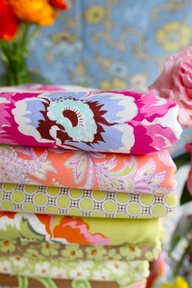 The modern quilting movement began in 1998 with fabric manufacturers introducing clear-toned, bright-colored fabrics. One of the first and most popular collections was “Gypsy Caravan” designed by Amy Butler. Near the same time, Denyse Schmidt introduced more contemporary quilt designs, such as her popular “Single Girl” pattern.
Then, with the increasing affordability of digital camera, quilters began to share their work on their blogs and sites like Flickr. Fresh Modern Quilts continues to be a popular site for modern quilts. And technology continues to be the communication tool for modern quilters. Through quilt-alongs, block of the months (BOM), tutorials, and the like, quilters stay in touch and keep abreast of current quilting trends.
Modern quilts can be defined by these characteristics:
Style and Design
- inspired by modern art and architecture
- simplicity, minimalism
- reinterpreted traditional blocks, called “modern traditionalism”
- alternative block structures
- lack of visible block structure
- negative space
- asymmetry
Fabric and Color
- bright
- graphic
- low-volume
- gray or white as neutral
- solid fabrics
Technique and Construction
- improvisational piecing known as “wonky”
- pixelation
- no borders, or borders are part of negative space
- quilting is by the quiltmaker, on a home sewing machine
- straight-line and organic quilting are common
The above-named elements can take a variety of forms and work in combination with other elements to create modern quilts.
At Central Florida MQG meetings, we strive to emphasize modern quilting in our programs and Show and Tell, and educate quilters about modern quilting.
Please print, complete, and submit this Show and Tell form when sharing a quilt at a meeting.
 centralfloridamqg.org